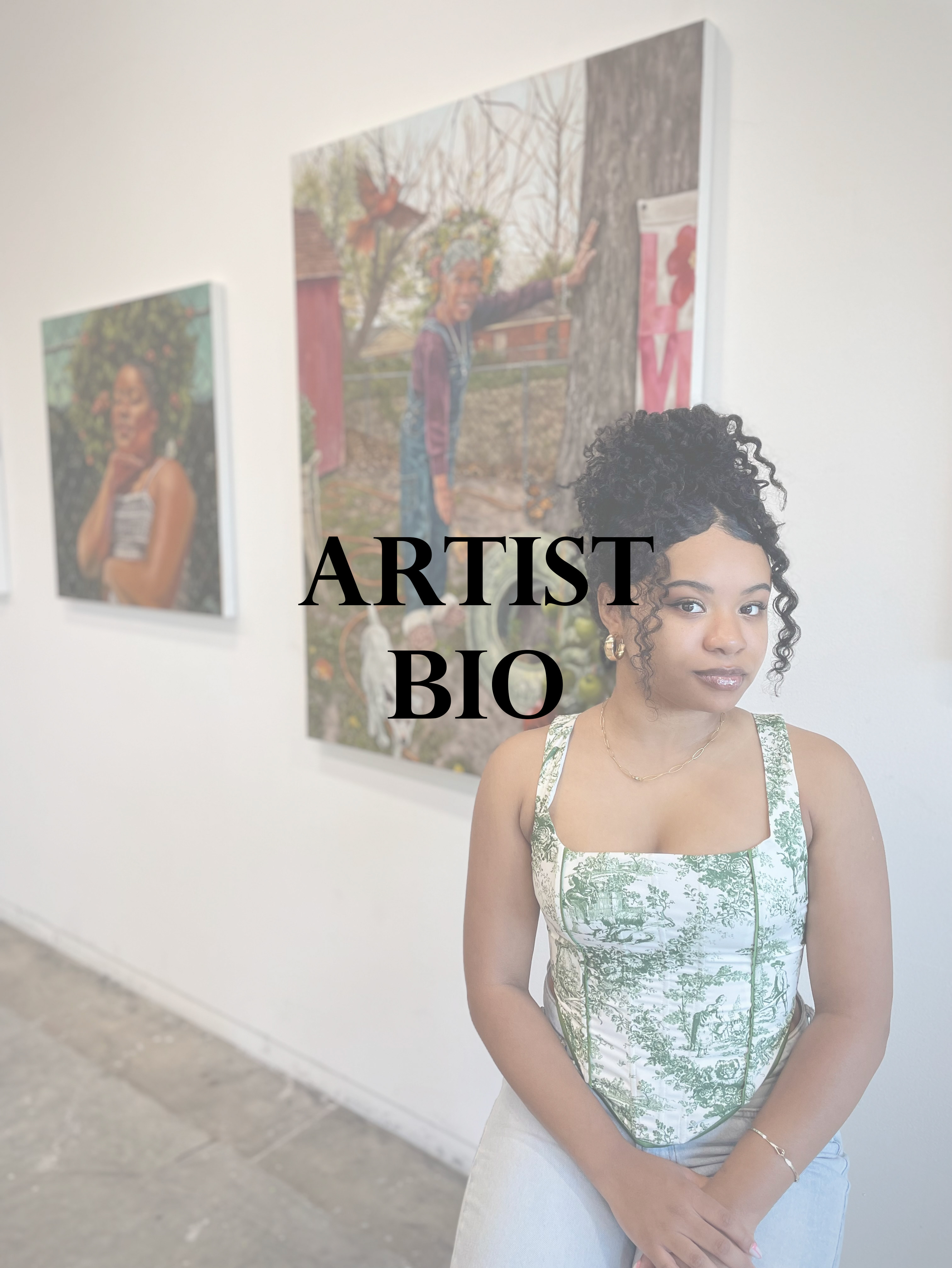
My work uplifts everyday Black people by placing them front and center in high detail. The work highlights the rainbow of colors that build their skin tones, their moles, freckles and scars, the kinks and coils of their hair, and the fabrics they adorn their bodies with. This celebration of their beauty is needed, and deserved, in a world where people of color have been systemically conditioned to hate themselves and each other to allow racist, classist, patriarchal systems to thrive.
The symbols of my work, the cardinal, signs of industry, and weeds, illustrate how America’s racialized past impacts people of color today. Since it is a common belief that seeing a cardinal means a loved one who has passed is visiting you, I use them to symbolize spiritual and ancestral guides for the figures I paint. The birds’ presence in the paintings speaks to the troubled history of African Americans in this country, having to endure inhumane racism, injustice, and punishment for their skin. However, the presence of the figures themselves provides evidence of generations of Black people overcoming, healing from, and thriving despite these hardships. The markers of industry in my pieces, like powerlines and cranes, represent hierarchical power structures, the need to reconstruct America systemically due to its foundation of racism, and man’s claim over nature. This is similar to his attempt to claim human bodies. In the end, nature will outlast and break free from man’s temporary claim to it, like how people of color have broken free from the shackles of enslavement. Weeds and other foliage are employed to adorn the figures, as well as highlight overlooked moments of beauty in our landscape. Many minority neighborhoods are often stripped of nature, leaving concrete and pollution, but weeds grow in the cracks to bring signs of life back to the landscape. This view of weeds as a nuisance, and their ability to grow in the toughest of conditions is similar to the resilience of people of color in America. These symbols not only reveal the attempts to destroy the will of minority groups, but how these groups continue to progress.
As a Black woman working mainly in oil paint, and in thinking about its use in the Western Art canon as a medium of the White, male, masters, I am celebrating and valuing the Black figures who have been historically excluded from this mode of representation. “Victory”, like many of my other pieces, challenges the Eurocentric lens “beauty” has largely been defined by in our Western society, where Greek gods and goddesses represent the epitome of perfection. In this piece, the Black woman being depicted and plant potter of a Greek goddess sit next to each other at a table. The statuette holds a small plant on her head while the young woman’s head is adorned with a bouquet in the formation of a halo. The halo is a symbol that was often used in Western art history, but largely not for people of color. The use of flowers and common weeds to build the halo speaks to hierarchies that reach as far as our natural landscape. Every plant, like every person, has their own value in our world, and I believe the resiliency of weeds has similarities to the resiliency of people of color in this country and beyond. The playing field between Greek gods and goddesses and everyday people of color is also leveled by the “Nike” hat the young woman is wearing. Nike, the goddess of victory, has been made more accessible through the brand that many people wear on a day-to-day basis, showing that they are also worthy of what the goddess represents.
My large-scale canvases and close-up perspectives allow viewers to engage with the painted figures directly. In “The Coronation”, the young man on the steps and the grandmother on the porch gaze out at viewers, acknowledging their presence. This acknowledgement protects the family in their intimate moment by showing their awareness and autonomy. The placement of the boys on the stairs, the women on the porch, and the railing provide further protection of the safe space of their home. The gazes are also an invitation to join the moment and to get to know the figures in their space through their individual details. This scene of my mother, sister, and two nephews allows viewers to connect to the piece by illustrating a familiar scene they can imagine their own loved ones in. I often paint family and other people I know so my care for them translates to the audience. This feeling of familiarity helps viewers to humanize the painted figures; therefore, directly challenging the dehumanization we have been taught to use against strangers with different backgrounds and life experiences than us.
Through my work, I aim to celebrate the dynamic beauty and strength of everyday people of color despite the immense struggles of our past, and despite the work we still have to do.